
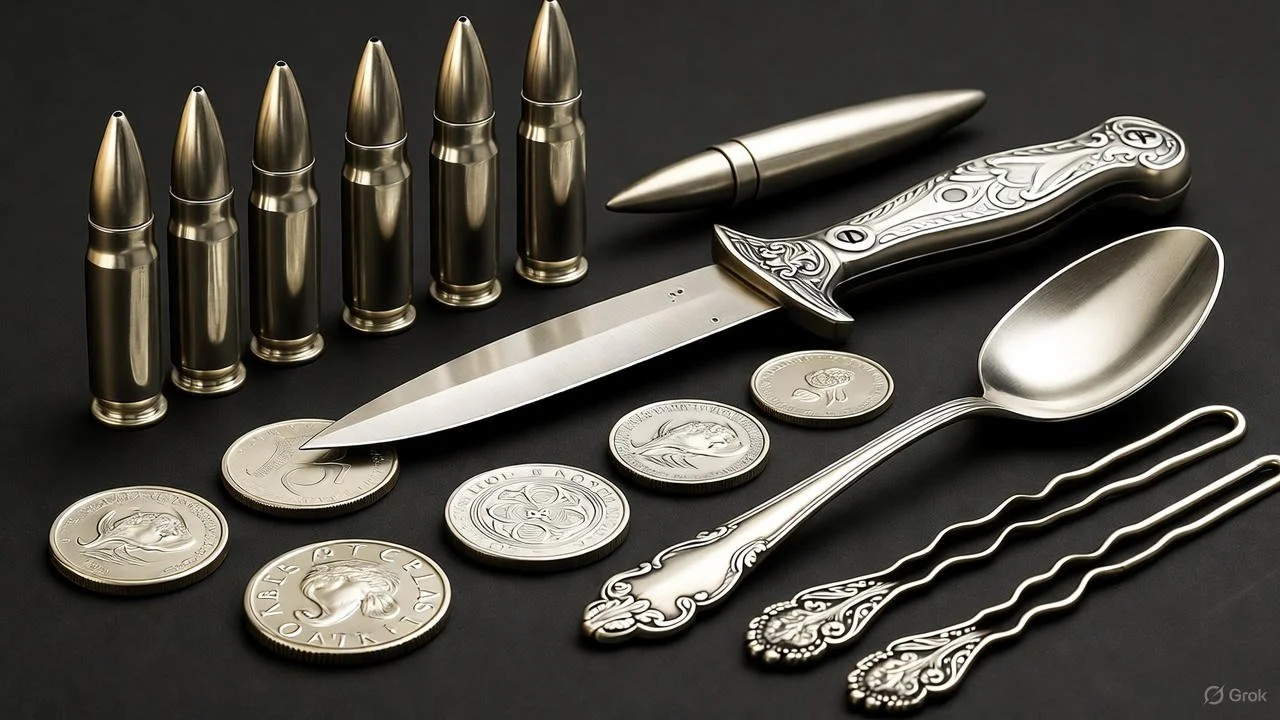
“Blessed silver burns the demon like holy fire.”
Silver
Silver has been employed across the ages and throughout the world as a ward and weapon against supernatural entities. Religious texts, ecclesiastical records, tribal oral traditions, and eyewitness accounts preserved in folklore and religious practice attest to its potency.
Our team keeps silver on hand for every encounter, because it has been proven to be the most potent physical material to react to the broadest range of paranormal entities. Due to its cost, and that purity of the silver is a requirement for its effectiveness, the amount of silver equipment we carry in the field is limited. Just for an example, the silver knife Turtle carries in the field, used 10 troy ounces of silver to cast, amounting to almost $500 US dollars in just silver bullion. So simply for its cost and difficulty in crafting, we always keep silver, but its use…like silver bullets…is done sparingly.
Europe: Vampires, Revenants, and the Undead
Serbian Military Report (1732): The Habsburg commission’s Visum et Repertum, signed by five officers, documents the case of Arnold Paole and other revenants in Medvegia. Corpses were exhumed showing undecayed flesh and fresh blood. Silver nails were driven through the hearts and silver coins placed in the mouths of the bodies, causing the bodies to shriek and collapse into dust [Visum et Repertum, 26 Jan 1732, published in Nurembergische Gelehrte Zeitung, 1732; silver-coin practice corroborated in Murgoci, The Vampire in Roumania, 1926, citing 18th-c. parish records].
Transylvanian Orthodox Practice (17th–18th c.): Priests recorded in parish books that silver crucifixes pressed to a suspected strigoi’s lips produced burns and forced confession of nocturnal attacks [Acta Historico-Ecclesiastica synodal reports, 18th c.; silver-crucifix detail in Summers, The Vampire in Europe, 1929, citing Transylvanian church archives].
Greek Vrykolakas (Cyclades, 1700s): Island chronicles note fishermen melting inherited silver drachmas into bullets. A single shot to the navel caused the corpse to deflate and remain inert [Tournefort, Voyage into the Levant, 1717; bullet-to-navel detail in Lawson, Modern Greek Folklore, 1910, citing 18th-c. island oral testimony].
Germanic and Slavic Lands: Werewolves and Shape-Shifters
Livonian Werewolf Trials (1692): Court records of Thiess of Kaltenbrun stated that he and and fellow Gottes Hunde (Hounds of God) carried silver-tipped whips to drive hell-hounds* back to the underworld each winter solstice [Livonian court transcripts, 1692, published in Ginzburg, The Night Battles, 1983; Silver Whips in Die Volkssagen Livlands, 1860s].
*As an aside, I recently- 4 months ago -had a brief encounter with a hell hound. Simply a visual sighting at an investigation sight. It was definitely a memorable encounter. Reading these accounts as I put this post together make me remember how dangerous that creature appeared. -Turtle
Celtic Realms: Fairies, Changelings, and the Sidhe
Scottish Highlands (1691): Minister Robert Kirk’s The Secret Commonwealth—written before his own abduction—advises ringing a silver bell three times at a fairy mound to compel the fae to return a stolen child [The Secret Commonwealth of Elves, Fauns and Fairies, 1691 ms., ed. 1815].
Irish Leannán Sí (Munster, 1830s): Oral testimony collected by ordained clergy recounts a blacksmith forging a silver horseshoe nail; driven above a cradle, it banished a changeling that left behind the true infant [Keightley, The Fairy Mythology, 1828; Munster nail ritual in Ordnance Survey Letters, 1830s].
Scandinavia: Trolls, Draugr, and Huldrefolk
Icelandic Draugr (Eyrbyggja Saga cycle, 13th c. redaction of older oral law): The undead Glámr was killed for good only after a silver-inlaid spear—blessed by a bishop—was thrust through his chest; the weapon smoked and the corpse crumbled [Eyrbyggja Saga, ch. 34, 13th-c. ms.; silver spear in Árnason, Icelandic Legends, 1864].
Norwegian Troll Repellent (Bishoprics of Nidaros, 15th c.): Churchwardens’ inventories recount silver chalices being lent to rural parishes that were under siege by trolls. The parishes poured silver droplets on thresholds of the church and homes, preventing the hulder (trolls) from entering and attacking parishioners [Nidaros cathedral inventories, 15th c.; droplet ritual in Asbjørnsen & Moe, Norske Folkeeventyr, 1841–44].
Eastern Traditions: Demons and Hungry Ghosts
Japanese Onmyōdō (Heian period, 9th–12th c.): The Konjaku Monogatarishū gives us testimony from court exorcist Abe no Seimei. Abe no Seimei used a silver mirror to bind and seal a kitsune (demon). [Konjaku Monogatarishū, vol. 27, tale 17, 12th c.].
Tibetan Buddhist Protector Practice (14th c. onward): Holy texts prescribe silver phurba (ritual daggers) to pin infernal entities. Lamas reported the silver blade hissing upon contact with the possessing entities [Padmasambhava terma cycles; silver phurba use in Nebesky-Wojkowitz, Oracles and Demons of Tibet, 1956, citing 14th-c. texts].
Mesoamerica and the Andes: Night Spirits and Pishtaco
Quechua Oral Tradition (Colonial extirpation records, 1650s): Andean medicine women testified that silver kills pishtaco (translates as fat-cutter - a supernatural undead predator that kills humans for their fat). Silver can be driven into the creature directly, as a bullet or silver pin, or even into its shadow. Either causes the fat-stealer to dissolve [Huamanga extirpation trials, 1650s, in Mills, Idolatry and Its Enemies, 1997].
Maya Daykeeper Accounts (Popol Vuh commentaries, 18th c.): Silver beads strung on red cord and worn during Wayeb prevented the descent of x-tabai (infernal seductresses) [Chilam Balam commentaries; silver beads in Ritual of the Bacabs, ms. 18th c., trans. Roys 1965].
North America: Skinwalkers and Wendigo
Navajo Hatałii (recorded 1930s by Franciscan missionaries): Medicine men melt U.S. silver dollars into bullets. A single round fired into a yee naaldlooshii’s track forces reversion to human form and death [Kluckhohn, Navajo Witchcraft, 1944, citing 19th–20th-c. hatałii testimony].
Ojibwe Midewiwin Scrolls (birchbark, 19th c.): Pictographs show a silver knife cutting the heart-string of a windigo. Illustrations show a silver blade would glow white when the wendigo is near [Densmore, Chippewa Customs, 1929, pl. 47; birchbark scrolls].
Africa: Witchcraft and Revenants
Akan Priest-Kings (Gold Coast, 1700s): Court chroniclers note silver dust sprinkled along palace thresholds repels obayifo witches who feed on life-force [Bosman, A New and Accurate Description of the Coast of Guinea, 1705; silver-dust practice in Rattray, Ashanti, 1923].
Zulu Sangoma Testimony (19th c.): Healers hammer silver coins into anklets; the ringing repulses tokoloshe imp familiars [Callaway, The Religious System of the Amazulu, 1870, pp. 260–61].
Ancient Near East: Lilitu and Shedim
Babylonian Incantation Bowls (6th c. CE): Aramaic texts record the use of silver amulets to bind Lilitu night-demons. Silver is called “the moon’s bone” that severs their wings [Montgomery, Aramaic Incantation Bowls, bowl 8, 1913].
Talmudic Tradition (Bavli Pesachim 112b): Rabbi Hanina counsels carrying a silver coin stamped with a menorah to blind pursuing shedim [Babylonian Talmud, Pesachim 112b; Rashi commentary, 11th c.].
All of these accounts demonstrate silver’s use in combating evil, specifically dangerous fae and infernal creatures. The use of silver spans the world, has records dating back centuries, and is found across belief traditions with no contact between one another. Consistently they affirm that silver - whether forged into a weapon or bullet, a carried token coin or nail, or even silver dust - possesses an inherent potency to bind, repel, or destroy dangerous entities. Entities that iron, steel or other physical attacks cannot deter. The testimony of priests, shamans, soldiers, and exorcists alike treats the metal’s power as observable, repeatable, and essential for survival in a world where the inhuman appear.