The belief in the evil eye (that envy, malice, or unguarded attention can bring misfortune) predates written language. Its antidote, the Nazar, has endured for over 3,000 years, protecting soldiers, sailors, merchants, and travelers from forces that attack not the body, but the spirit.
The first known eye-shaped amulets appear in Mesopotamia and ancient Egypt, where they were carved into lapis lazuli or faience and placed over the heart to deflect curses. In Classical Greece and Rome, warriors painted eyes on ships to “see” and ward off storms and ill intent. The symbol followed trade routes through Persia and Anatolia, where glass-makers in 15th-century Ottoman Turkey perfected the blue-and-white design still recognized today. Their choice of cobalt glass was no accident. Blue was believed to absorb and neutralize hostile energy, a hue sacred to the sky and the divine watchfulness above.
Even now, its purpose is unchanged: reflect the gaze of harm back upon itself.
See without being seen. Protect without striking. The eye watches for you.
Description:
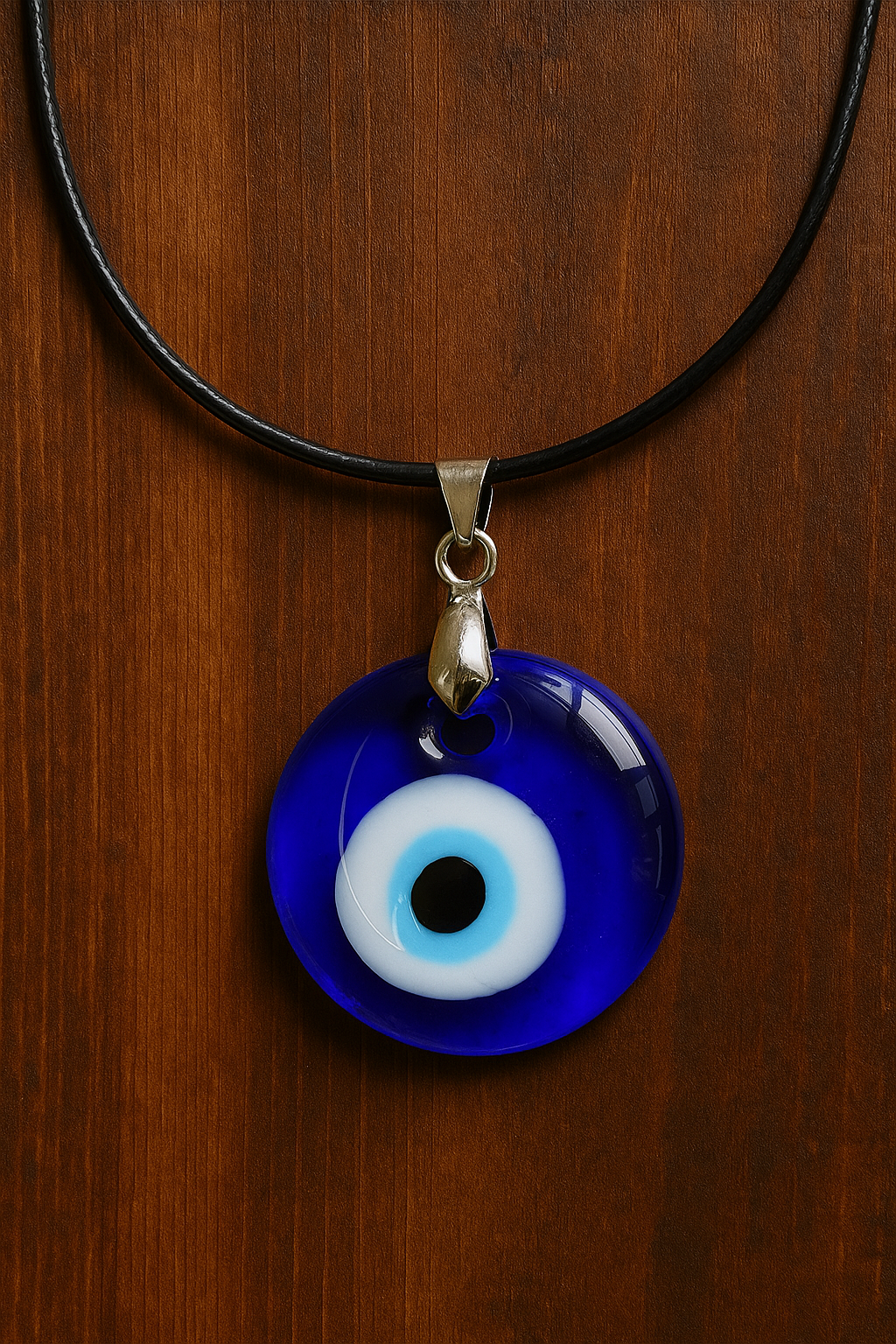
Pendant is blue glass; size 1 and 3/16 inch
Rope chain is 17.8in with 2in extension chain, you can adjust the length of necklace with adjustable extension chain.
The belief in the evil eye (that envy, malice, or unguarded attention can bring misfortune) predates written language. Its antidote, the Nazar, has endured for over 3,000 years, protecting soldiers, sailors, merchants, and travelers from forces that attack not the body, but the spirit.
The first known eye-shaped amulets appear in Mesopotamia and ancient Egypt, where they were carved into lapis lazuli or faience and placed over the heart to deflect curses. In Classical Greece and Rome, warriors painted eyes on ships to “see” and ward off storms and ill intent. The symbol followed trade routes through Persia and Anatolia, where glass-makers in 15th-century Ottoman Turkey perfected the blue-and-white design still recognized today. Their choice of cobalt glass was no accident. Blue was believed to absorb and neutralize hostile energy, a hue sacred to the sky and the divine watchfulness above.
Even now, its purpose is unchanged: reflect the gaze of harm back upon itself.
See without being seen. Protect without striking. The eye watches for you.
Description:
Pendant is blue glass; size 1 and 3/16 inch
Rope chain is 17.8in with 2in extension chain, you can adjust the length of necklace with adjustable extension chain.